Category: Architecture

A Poet For a Snowy Evening

The American poet Robert Frost taught at Amherst College in Amherst, Massachusetts for decades.

This eight-ton granite statue of Frost, created by sculptor Penelope Jencks, is featured in the Main Quadrangle at the college.

It depicts a seated Frost holding a book.
He is looking toward the library that is named in his honor.
The backdrop to the statue is the Mt. Holyoke range.
A perfect place to consider your own promises to keep.
Stopping By Woods on a Snowy Evening, by Robert Frost

Whose woods these are I think I know.
His house is in the village, though;
He will not see me stopping here
To watch his woods fill up with snow.

My little horse must think it queer
To stop without a farmhouse near
Between the woods and frozen lake
The darkest evening of the year.

He gives his harness bells a shake
To ask if there is some mistake.
The only other sounds the sweep
Of easy wind and downy flake.

The woods are lovely, dark and deep,
But I have promises to keep,
And miles to go before I sleep,
And miles to go before I sleep.

Stone, Glass, Wood / 1888-2026

The Gale Free Library of Holden, Massachusetts exemplifies adaptive reuse architecture, where old buildings are updated for modern uses while still preserving their historic character.

Built in 1888, the library was originally a high school.
Historic stained glass windows are being restored.
The original stone exterior melds with a modern interior extension.
An enlarged historic photograph greets visitors to the second floor.
Wood beams and lighting soften the stone, while the rooflighting above floods the space with light.

The Children’s Room is currently being updated, but a peek through the door hints at learning and fun to come.
In the reading room room traditional statuary and stained glass windows are enhanced with tiny golden lights.

Click on post title to view comments and related posts if they are not visible below.

A Cathedral in the Pines

A lightly edited version of a previous post.

New Hampshire’s Cathedral of the Pines  is an open-air complex built as a memorial to the American war dead. It includes a multi-denominational sanctuary and features a scenic view of nearby Mt. Monadnock.

Continue reading “A Cathedral in the Pines”

Cathedral of the Pines, Part One

New Hampshire’s Cathedral of the Pines  is an open-air complex built as a memorial to the American war dead. It includes a multi-denominational sanctuary and features a scenic view of nearby Mt. Monadnock.

The Women’s Memorial Belltower is believed to be the first monument in the United States devoted to women’s service and sacrifice.

The Altar of the Nation was recognized by Congress in 1957 as a  National Memorial to American men and women who lost their lives in war. The stones that make up the main body of the Altar come from all fifty states and from every United States President since Harry Truman.

Breakfast With Mary’s Little Lamb

“Mary had a little lamb,
Its fleece was white as snow,
And everywhere that Mary went
The lamb was sure to go.

It followed her to school one day,
Which was against the rules,
It made the children laugh and play
To see a lamb at school.”

-John Roulstone

This beloved children’s rhyme is actually a true story, which had its origin in the little town of Sterling, Massachusetts. You can read a fascinating history of the rhyme here.

Mary Sawyer, born in 1806, did have a lamb she loved. And the lamb did indeed “follow her to school one day” (with a bit of help from Mary and her brother).

The architecture around the town common, some which dates back to the 1800s , would have been a familiar sight for Mary and the lamb.

Signs remind us of other historical links of importance, as well, such as a visit from General Lafayette…

Or that the world’s first sewing pattern featuring multi-sizing was invented in Sterling by Ebenezer Butterick over 150 years ago.

Who wouldn’t enjoy breakfast overlooking Sterling Common while imagining how a little lamb (as well as a French general and a creative sewing genius) played a part in the town’s history?
Consider this!

¡Delicioso!

Third Generation farmers from Nicaragua roast and sell coffee from around the world in this delightful Holden, Massachusetts coffee shop.

Wall murals help customers visualize coffee beans on the vine.
Brilla means “shine” in Spanish.
Learn more about the farms and coffee here.
A coffee bean ceiling!

Roasted coffee can be purchased in-store or online.
The on-site roastery.
French Toast and Huevos Rancheros on a bagel.
Traditional style furnishings.

Relevant Yesterday and Today

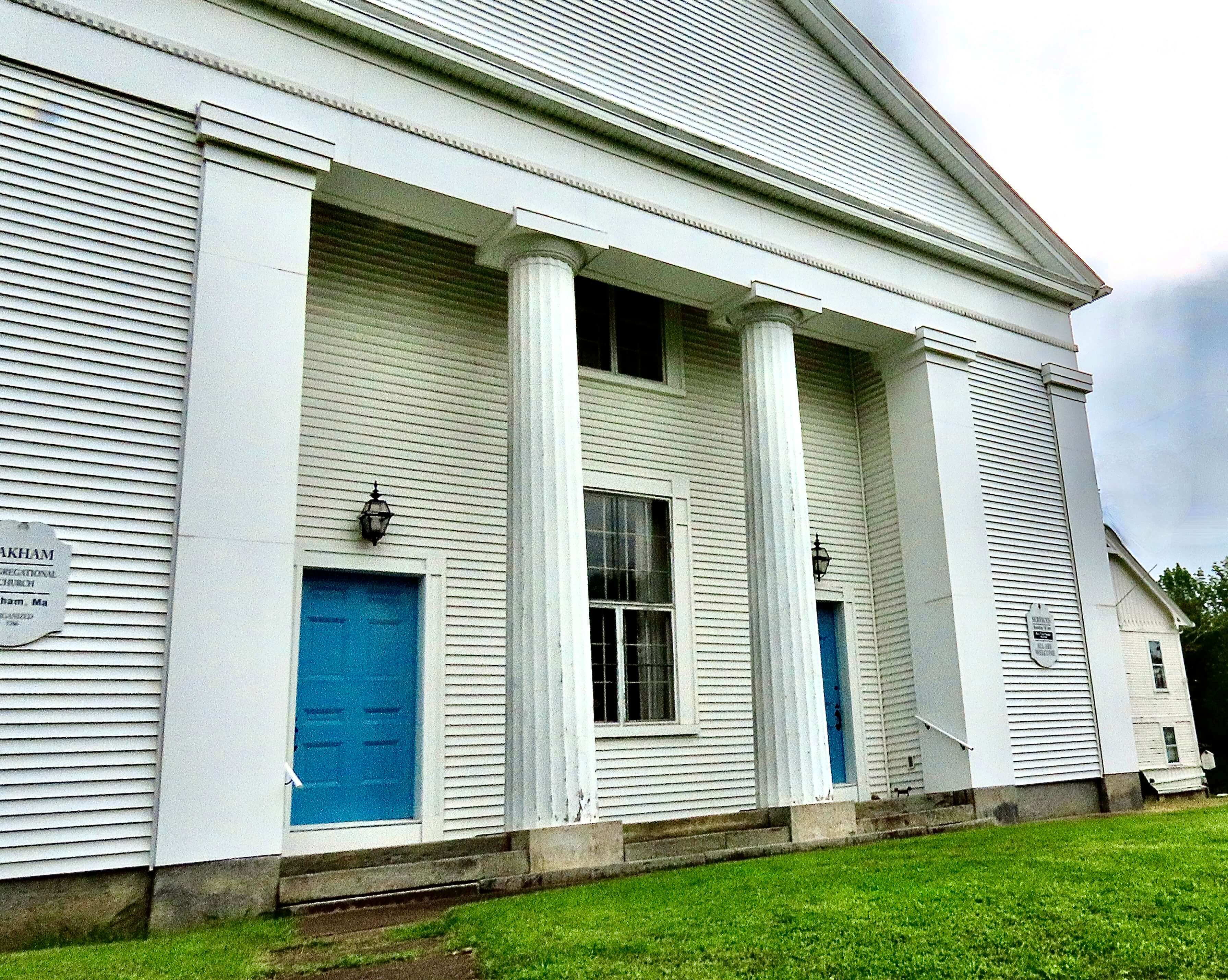
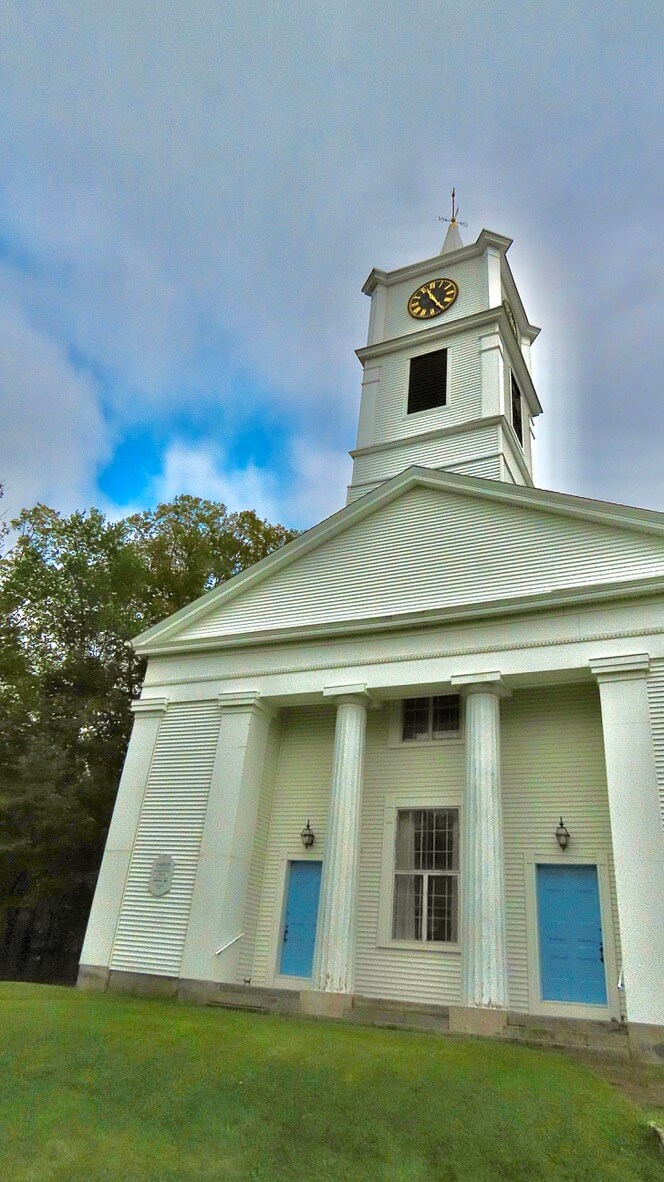
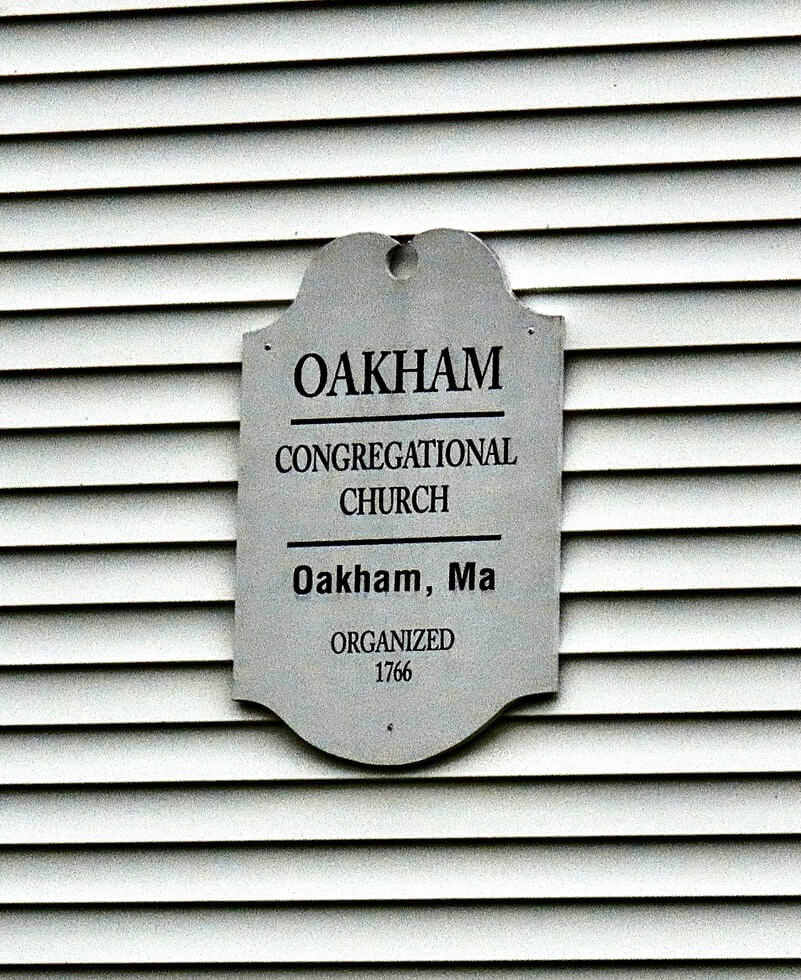
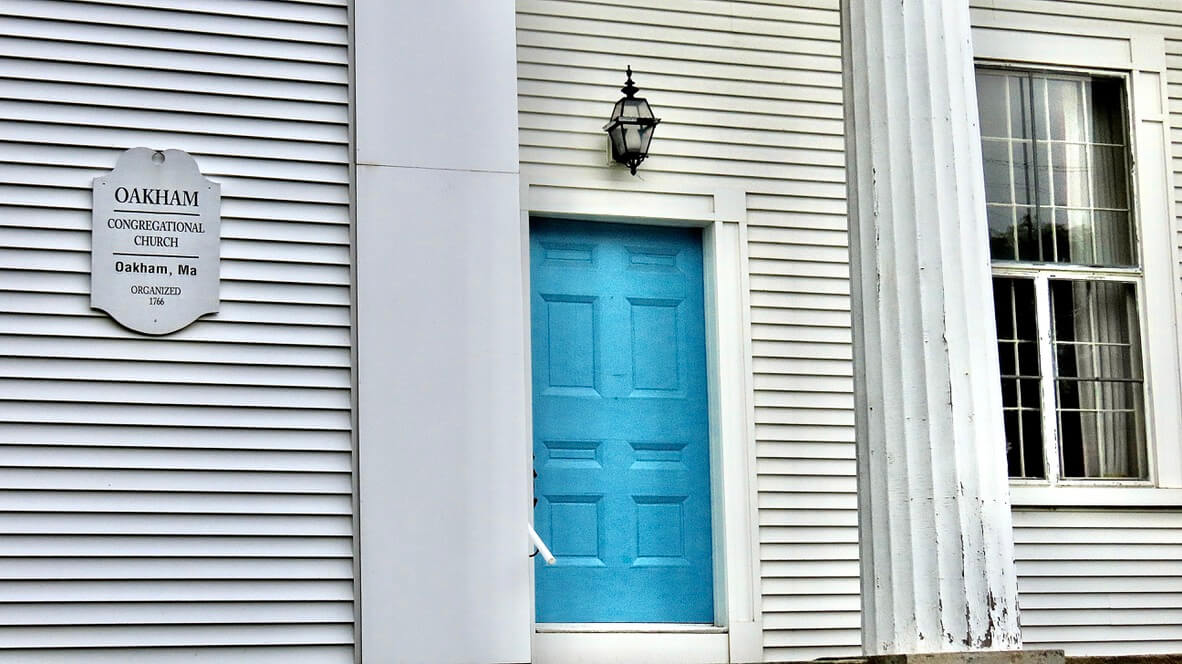
This classic New England style church in Oakham, Massachusetts (population 1,621) dates back to 1766. The Churchyard Cemetary, circa 1790, includes Revolutionary War soldiers.

SAR stands for Sons of the American Revolution, and honors those who served in the Revolutionary War.

For over 257 years, this site has been a gathering place for solace and reverence.

Winsor Dam

The Winsor Dam and the Goodnough Dike impound the waters of the Swift and Ware Rivers, forming the Quabbin Reservoir, the largest water body in Massachusetts. The dam is one of the largest in New England.

A hilly walkway leads up to the dam.
View from one end of the top of the dam to the wide walkways and green spaces below.

Walking across the dam is a popular activity in the park.

Quabbin Reservoir as seen from one end of the dam. It is 18 miles long and up to six miles wide.
The 412 billion gallon reservoir is the largest man-made reservoir in the world devoted solely to drinking water supply.
From 1938-1946 four towns were flooded to create this vast reservoir. It supplies over 40% of Massachusetts with drinking water.

Water can form waves on windy days.

Uncovering the Past

The Ware-Hardwick Covered Bridge is one of eight covered bridges in Massachusetts. It is listed on the National Register of Historic Places.

Wikipedia states that:
At 137 feet, the Ware-Hardwick Covered Bridge is the longest covered bridge in Massachusetts.
Built in 1886, it spans the Ware River at Hardwick and Ware, Massachusetts.
The siding does not fully cover the sides, leaving a strip exposed for light, and extends partway inside each portal.

The bridge notably survived a major flooding event in the 1930s, when the textile mills in Hardwick were destroyed.

Revolutionary Timekeepers

The Willard House and Clock Museum in North Grafton, MA.

From the information board at the site:
The family of clockmakers who lived and worked in this house helped revolutionize timekeeping in America. The Willard family was one of the premiere clockmaking families during and after the American Revolution. The Willards held several patents on clockmaking innovations, and their work made clocks more widely available–while increasing their reliability.
The saltbox, a popular colonial house design, was a frame dwelling with two stories in front and one behind and a roof with a long rear slope.

Simon Willard invented the popular banjo clock, a wall clock with a banjo-shaped case.

First Snow, Part Two

The view driving away from the Town Common on Barre Road, Hardwick, MA.
“Meadowbrook” was part of a former dairy.
A typical colonial home of the late 1700s and early 1800s.
Thick, winding stone walls can be viewed throughout the town.
A traditional style Cape Cod home on Ridge Road.
A view of the Town Common, from the left to right: the First Universalist Church, the Historical Society and the Town Hall.
The bell tower of the Town Hall.
The Paige Memorial Fountain with fields beyond, which are used for showing sheep during the Hardwick Fair.
Paige Memorial Fountain with the Congregational Church and a Coffeehouse behind it. (The Coffeehouse was formerly the general store.)
The coffeehouse also includes the Hardwick Post Office.
An historical cemetery abuts the Town Hall.
Holiday decorations on the First Universalist Church capture the imagination.

A 1685 Garrison House

Standing for over 300 years, this sturdy house provides a glimpse into an important architectural style of Early America.

The Houghton Sprague Garrison House, Harvard, MA
“Garrisons, or fortified houses, were built in almost all New England towns.…Like an ordinary house in plan and appearance, garrisons were used in times of peace as one-family dwellings but were strongly built and capable of protecting a number of families in times of danger, like the American Revolution.” –The History of Garrison Colonials, by Ray Wiese

A Century Farm

Central Massachusetts boasts well over forty apple orchards. Sagatabscot is among the oldest.

Sagatabscot Orchards in Sterling, MA was established in the 1740s. This historic farm has been owned by only two families; the present family has been operating it since 1912.
A self-serve stand offers many apple varieties, including heirloom, as well as cider.

The antique cider press has been preserved in the farm barn along with other historical relics. Note the World War I helmet, worn by an ancestor of the present owner.
In the Algonquin Indian language sagatabscot means “place of the hard rock”.
Since the 1700’s the owners have built numerous additions to the original buildings on the rocky hillside.

The farmhouse is painted in the original 1700s color.

The “six over six” windows and side entry are appealing details for colonial architecture enthusiasts.

Lucky and Lucky, the chickens, were named as a consequence of being the last chickens left after a fox found the hen house.

The barn is a treasure trove of antique farm implements, historical items and family lore.

Cart wheels and traditional Ojibwa Indian snowshoes are displayed in the barn rafters.
This bobsled was used to deliver milk when roads were impassable in the winter.
The present owner created this replica of the barn for his young daughters.
Generations of cousins have gathered at the farm for family festivities.
Small rooms carved out from the larger structure include historical items and family heirlooms.

Mindfulness

Photographs from a visit to the grounds of the Barre Center For Buddhist Studies in Barre, Massachusetts.

At the Barre Center for Buddhist Studies in Barre, MA thoughtful landscaping and architecture are designed to encourage reflection and contemplation in or out of doors.
Stone walls, sturdy trees, benches and other wooden elements recur throughout the grounds. Circular and domed shapes enhance architectural elements.
The large domed bell with striker is hung from a aged tree. In Buddhism, the bell is sometimes said to be the sound of the Buddha’s voice.
A dome-shaped stupa (a Buddhist monument housing sacred relics associated with the Buddha) is surrounded by greenery and stone walls.

The Meditation Hall features large circular windows. Circles are associated with enlightenment in Buddhist thought.

Wooden floors and exposed beams enhance the inside of the hall.

The vegetable garden is enclosed by a handmade willow fence. Garden sections are now being planted, as the Center will welcome on-site students once again this fall.

A wooden Thai Spirit House sits at the edge of the garden.

A Colonial Style Summer

A walk through the small historic district of Holden, MA allows time to view many details of colonial architecture and landscaping.

This home in the historic district of Holden, MA, displays the simple beauty of early American design and decoration. Lilies, phlox and daisies, traditional New England perennials, become the “front lawn”. No mowing needed.
The rest of the “lawn” is dominated by common ferns. Look closely to the left of the door. A golden colored “guard” is on duty there.
Door guards such as this one have been popular in China for centuries. This might be a representation of a lion, dragon or dog. Although I was unable to find direct links from this style of ceramics to early America, The Boston Tea Party Ship and Museum notes that: In 1741, ships belonging to the British, Danish, French, and Swedish brought a total of 1,200,000 pieces of Chinese porcelain into the European ports. A good portion of those pieces ended up in the fine homes of Boston, New York, Philadelphia, and Charleston. I welcome comments if you have expertise in this area!
A recent trend in primitive decorating is the use of gourds. Here, eye-catching Italian gourds (or possibly small snake gourds) hang on the side door underneath panes of traditional bull’s eye glass. The five-pointed star atop the door was a symbol of good luck in colonial America. A side lantern in colonial style utilizes faux candles.
The smaller golden guard of the side door sits next to a pot of basil. Basil was brought to the New World in the 1620s. Along with flavoring food, it was used as a strewing herb. Additionally, the leaves were dried for use in snuff to relieve headaches and colds.
Whitewashed picket fences were popular in colonial days. These fences were expensive and harder to maintain than plain wooden fences, so they became a symbol of prosperity.
This rooster weather vane, with its tail perfectly shaped to catch the wind, stands proudly atop the house. Weather vanes were popular in colonial times, but were first used centuries before this era.

Enchanted Architecture

The Enchanta Bridge, Moore State Park, Paxton, MA

One side of the bridge overlooks a large pond.

Generous ramps blend in with the traditional architecture while making the bridge universally accessible.
Adirondack chairs invite visitors to relax.
The pond provides opportunities for fishing, canoeing and skating.

The waterfall as viewed from the bridge.

A Grand Design: Beaver Architecture

Beavers build lodges from woven sticks, grasses, and moss plastered with mud. These architectural marvels can be up to 8 feet wide and 3 feet high inside. A lodge is designed with at least two underwater “doors” to provide instant swimming access, while a “skylight” hole at the top lets in fresh air. There are two main rooms inside – one near the entrance that is used for eating and drying off and another used for sleeping and raising the young. On average, between four and eight beavers live in a lodge.

Beaver Lodge, Wildlife Pond, Wachusett Meadow Audubon, Princeton, MA

Historic Yankee Barn Design

Information posted at Wachusett Meadow Audubon Sanctuary’s Crocker Barn states:

“Built in 1925 by the Crocker family, this barn formerly housed a herd of prize-winning Milking Shorthorn cattle. It was designed by farm manager Paul Beardsley and was state-of-the-art for its time, featuring a ground floor milking parlor, a trussed, gambrel roof that provided vast interior space to pile loose hay (hay balers were not yet invented), and an overhead tramway system to easily move manure to a separate barn for storage. No longer present, but visible in the historic photo notice the twin silos, the four rooftop ventilators, the additional hay wagon ramp, and the small milk house in the foreground.

Currently, the Cow Barn provides storage for the materials, tools and equipment needed for sanctuary habitat management, and to maintain our trail system, buildings and grounds. Planning is underway to fundraise for renovations that would allow us to welcome visitors and program participants into this wonderful and historic space.”

The Crocker Barn, Wachusett Meadow Audubon Sanctuary, Princeton, MA.

Information posted at Wachusett Meadow Audubon Sanctuary’s Crocker Barn states:
“Built in 1925 by the Crocker family, this barn formerly housed a herd of prize-winning Milking Shorthorn cattle. It was designed by farm manager Paul Beardsley and was state-of-the-art for its time, featuring a ground floor milking parlor, a trussed, gambrel roof that provided vast interior space to pile loose hay (hay balers were not yet invented), and an overhead tramway system to easily move manure to a separate barn for storage. No longer present, but visible in the historic photo notice the twin silos, the four rooftop ventilators, the additional hay wagon ramp, and the small milk house in the foreground.
Currently, the Cow Barn provides storage for the materials, tools and equipment needed for sanctuary habitat management, and to maintain our trail system, buildings and grounds. Planning is underway to fundraise for renovations that would allow us to welcome visitors and program participants into this wonderful and historic space.”
The barn circa 1925.
Doors to a former hay wagon ramp.
Attention to detail is shown on this simple but effective shingle design.
The cow barn is massive compared to the nearby sheep barn.
Fieldstone foundations are featured on both barns.
A section of the outsized doors, commonly found on New England barns.
The barn overlooks a meadow that leads down to wetlands.

This side of the barn will soon feature an all-persons viewing deck.

A Red Barn For All

This barn dating back to the 1800s is a Holden, MA landmark. The structure, with almost eight surrounding acres and a pond, was donated to the town in 2000. Now maintained by the non-profit organization, The Friends of the Red Barn, it is a center that helps people understand New England’s agricultural past while encouraging the appreciation of nature.

Six gardens are maintained on the plot by member/volunteers, and markers around the site educate visitors about the farm’s history. Farm Days offer a wide variety of events to experience farm life close up.

A Wayside Christmas Visit

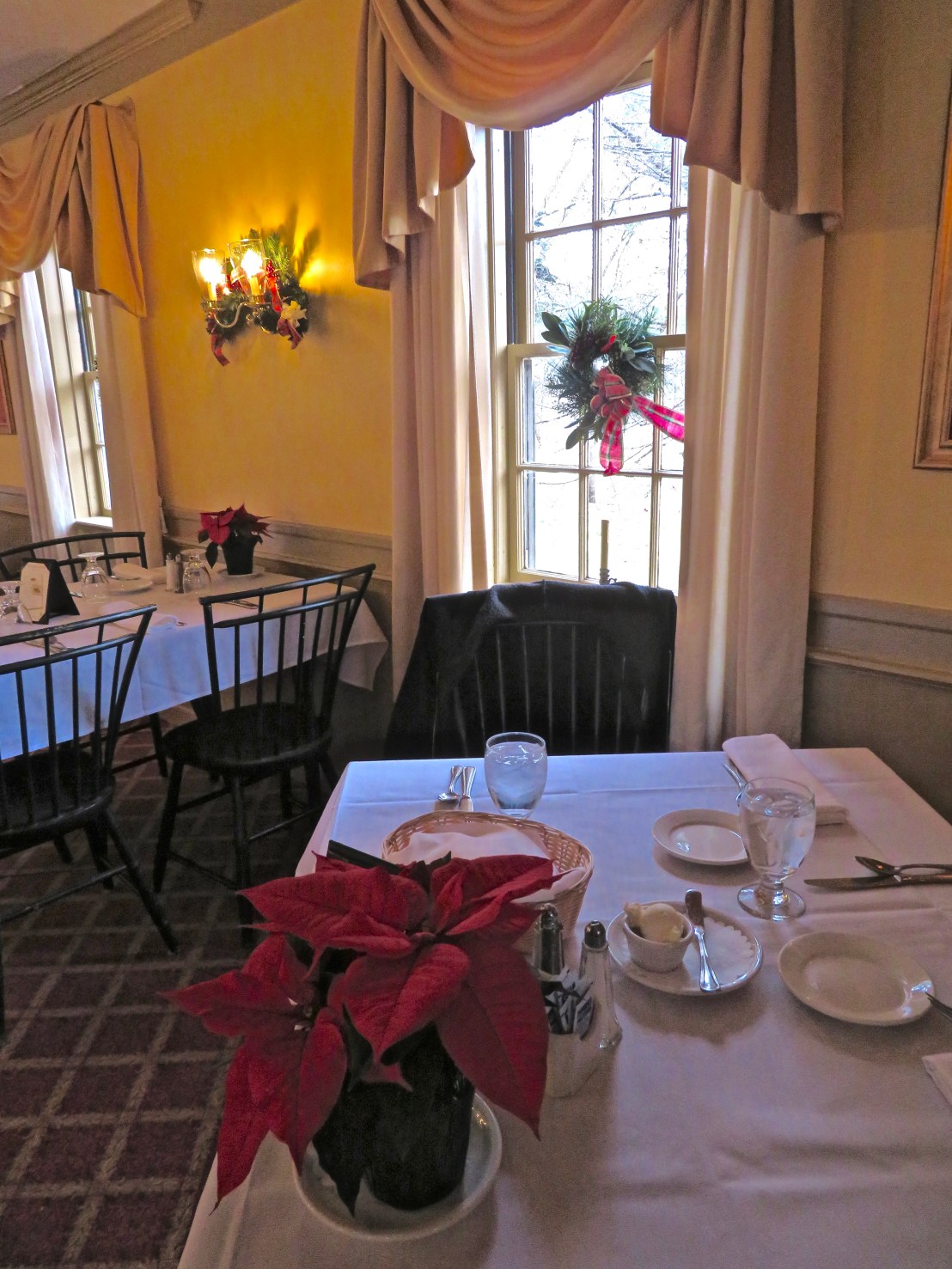
Longfellow’s Wayside Inn in Sudbury, Massachusetts is the oldest Inn still operating in the United States. It has been serving travelers along the old Boston Post Road for almost 300 years.

I lived in a colonial home built in 1791 for a number of years, so I recognize and appreciate the architectural sturdiness, twelve over twelve windows, pediments, stone walls and other 18th century features.

While I was eating a delightful traditional New England meal today at the Inn, two thoughts came to mind. Did Longfellow ever imagine that the Wayside would still be thriving in 2017? And had he also enjoyed a glorious Indian pudding like the one I just ate?

IMG_3019IMG_3008IMG_2932IMG_2940

This slideshow requires JavaScript.