On most summer evenings, beavers can be found foraging in the Wildlife Pond at Wachusett Meadow Wildlife Sanctuary. Last night was no exception.
According to the National Park Service:
The North American beaver is a keystone species, a unique organism that supports the entire biological community. The term “keystone” refers to a wedge-shaped block that forms the apex of a stone arch, the brick that holds the entire span in place. If you remove the keystone the arch collapses. The same can be true of a keystone species—their removal can contribute to an ecosystem collapse.
The dams that beavers build create wetlands that provide safe homes, feeding grounds and nesting areas for fish, birds, frogs, and mammals. They help to trap dirt and harmful chemicals and clean the water before it flows downstream. And of high importance in these times of global warming, the dams help to hold back water during heavy storms and slowly release stored water during dry summer months.
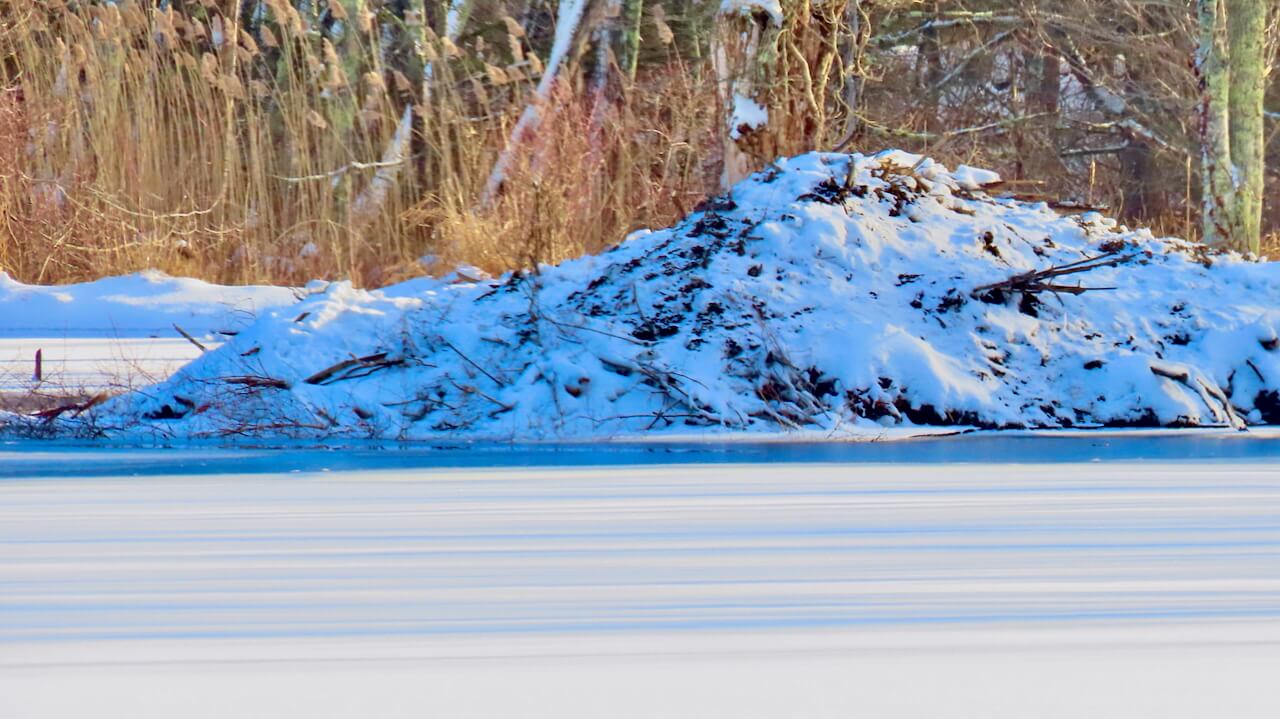
Beavers live in lodges like this one at Wachusett Meadow that sports a “late summer greenery” look. I’ve photographed this lodge in all seasons. Click here for some different lodge views. Click here to learn more about the design of the lodge.
Last night this single beaver busily munched lily pads, and barely noticed me a few feet away on the dock. I watched as it used its ten fingers to prepare and eat dinner.
This video from a previous post shows the hands at work.
In this video short, a juvenile otter’s cry can be heard as the the beaver forages. Although the beaver paused each time it heard the otter, it remained unconcerned. Shortly after the beaver dives, the abrupt splashing of otters diving nearby can be heard.
The otter family that swam quickly by can thank the beaver for this environment . Otters and beavers are not “friends”; rather they are more like neighbors who tolerate each other. Occasionally, an otter might pose a threat to a young beaver, as otters are carnivores.
The lower left edge of this photo shows the observation dock where I was standing. I managed to take one photo of the otters before they dived away. There is plenty of space for both otters and beavers to live here. Over the years, I’ve photographed many other creatures who depend on the beavers for their habitat. You can view a selection of them below.
PhoebeGreen FrogPainted TurtlePainted TurtlesCanada Geese With Goslings Kingfisher Canada Goose and MergansersWhite-tailed DeerGreat Blue HeronRed-wing BlackbirdOtterMallards
I live a few miles from Mt. Wachusett in Princeton, Massachusetts, the highest point in Massachusetts east of the Connecticut River. It is a monadnock, a rock that resisted erosion better than the surrounding land and stands alone above the lower hills. I think it is appropriate that this isolated peak that endured hundreds of millions of years in this manner is also called a “survivor“ mountain.
This “survivor” can be seen rising above the lower lands from numerous settings in the surrounding towns, and is a celebrated landmark in the region. Here, it rises above the farmland in Sterling, Massachusetts.
Earlier this spring, a roadside walk near the mountain’s base revealed both its rock structure and a quintessential spring woodland vista. Boulders tumble along the hilly roadside, and a hardwood forest grows among the rocks.
Caves and shelters are covered by maple alumroot, a member of the coral bell family, common in New England.
The alumroot looks surprisingly like a carpet of maple leaves.
Monadnocks contain singular large upstanding rocks called “glacial erratics”, which were likely deposited during the last ice age over 400 million years ago.
The top third of this glacial erratic displays reddish colored rock tripe, an edible lichen known as “famine food” . It was consumed by early European explorers, indigenous peoples, and George Washington’s starving troops during the winter at Valley Forge. It is very bitter and must be boiled before eating.
Hardwood tree roots share space around and on top of large boulders. Tree trunks sometimes grow in the rock space itself. In contrast, a common red maple sapling is just beginning to grow in this crowded area.
This “cave” is formed by metamorphic rocks ( rocks that have been transformed by heat, pressure and chemical reactions deep within the Earth) . Natural rock shelters such as these are believed to have been used by the Nipmuc people, who made their home here before European colonization. In fact Wachusett means mountain place in the Nipmuc/Algonquin language. These caves were likely used for protection from the elements, or for the storage of food.
Trees growing out of rocks and bending toward the light are demonstrating phototropism, the manner in which plants naturally grow towards light sources.