Category: Spring

Ancient Irises

A lightly edited reblog of a post from this day in 2021.

Iris means “rainbow” in Greek.

In Greek mythology, the goddess Iris carried messages from heaven to earth on the arc of the rainbow. Beautiful flowers appeared wherever she set foot on the ground.

Irises in a rainbow of colors are blooming in my garden this week!

The Wabash Tall Bearded Iris, introduced in 1936, an is an award-winning heirloom flower.

A group of Honorabile Iris. This vigorous heirloom bearded iris was introduced in Paris in 1840, and carried across the United States by the pioneers.

The Amas Iris was collected in Turkey in the late 1800s. It is larger than many other irises.

Pallida Sweet Irises are prized for their sweet grape-like or powdery scent. Many modern irises have only a mild scent, or no scent at all.

Welcome Back

After a long snowy winter, old favorite flora and fauna are once again reappearing in my yard.

A Juvenile Gray Catbird enjoys a bath.

American Cranberrybush Viburnum

Boomerang Lilac

Flame Azalea

Pink Rhododendron

The Eastern Bluebird builds a home.

Pagoda Dogwood

A juvenile Eastern Cottontail Rabbit hides among Solomon’s Seal and Robin Runaway.

Our perpetual goose visits the Red Azalea.

Even this particular heron came back to admire the rhododendron blossoms.

Our Zen Garden houses favorite statuary and seasonal visitors.

It overlooks the woods, which is filled with many types of wildlife.

Edible Petals

The Baldwin apple tree in my yard is teeming with blossoms this week. This classic heirloom apple was discovered around 1740 in Massachusetts. It became the most popular and commercially successful variety in New England right up until 1934, when a deep freeze killed millions of the trees, nearly wiping out the variety.

Baldwin blossoms are part of the rose family, and the petals are edible. They are noted for being highly fragrant and sweeter tasting than modern apple varieties. They can be used as a garnish for salads or desserts, in herbal teas, infused in liqueur or even made into apple bossom jelly.

Holden, MA

Rafts and Paddlings

A “raft” of ducks is a collective noun for a group of ducks who gather together as they float on the water. A “paddling” of ducks describes how a group moves across lakes, ponds or rivers with synchronized , graceful movements. I look forward to the March arrival of hooded mergansers at Wachusett Meadow Wildlife Center soon, whether they are rafting or paddling.

This raft of hooded mergansers are diving ducks that have a serrated bill designed for catching fish. Along with other mergansers, they are the only North American ducks specializing in eating fish. They are excellent divers, and can go as deep as thirty feet.

The male hooded merganser looks like this when relaxing…

or can raise and lower a large fan-like crest or “hood” on his head like this. The crest is raised during courting or when then duck feels threatened.

Two male Mergansers with crests down…

and three paddling with crests raised.
This raft of female mergansers sports smaller crests of a cinnamon-brown shade.

The crest is sometimes described as a “punk rock hairstyle”.

Male mergansers have intense, bright yellow eyes while the females’ are brown or reddish-brown. Their eyes are specially adapted to allow them to see clearly while fishing underwater.

It can be difficult to photograph hooded mergansers, as they are shy and paddle fast. They are sensitive to sound and movement, and move away quickly when approached. I’ll be waiting -quietly -to photograph whatever fleeting moments are possible.

Close Up and Far Away

Female, Male and Juvenile Hooded Mergansers on the Wildlife Pond
Blue Jay and Northern Cardinal Near the Bird Feeders
Gray Squirrel Swinging in the Copse Near the Bird Feeders
Common Grackle Hunting Seeds on the Ground
Female and Male Mallard on the Far Side of the Wildlife Pond
Eastern Cottontail with a Gray Squirrel and Sparrows Near the Visitor’s Center
Eastern Towhee and Blue Jay Under the Feeders
Eastern Cottontail Close-up
Eastern Towhee Under the Bird Feeders

Did You Hear?

An Eastern Meadowlark, which is becoming rarer in many parts of Massachusetts, visited the Audubon Sanctuary recently.

“There’s a Meadowlark in the South Meadow!”
“Heads up, Painted Turtles!”
The Red-winged Blackbird, Mourning Dove and Northern Cardinal have a plan.
“Let’s go check it out!”
The Eastern Meadowlark rests in the grass.

Bluebird Picnic

Eastern Bluebirds flew into town and invited their friends for a feast at the feeders.

Male Eastern Bluebird, Wachusett Meadow Wildlife Sanctuary, Princeton, MA
Female Eastern Bluebird
Female Bluebird, Blue Jay, Female Cardinal

Female Bluebird, Gray Squirrel

Downy Woodpecker, Male Bluebird

Nature’s Stitchwork

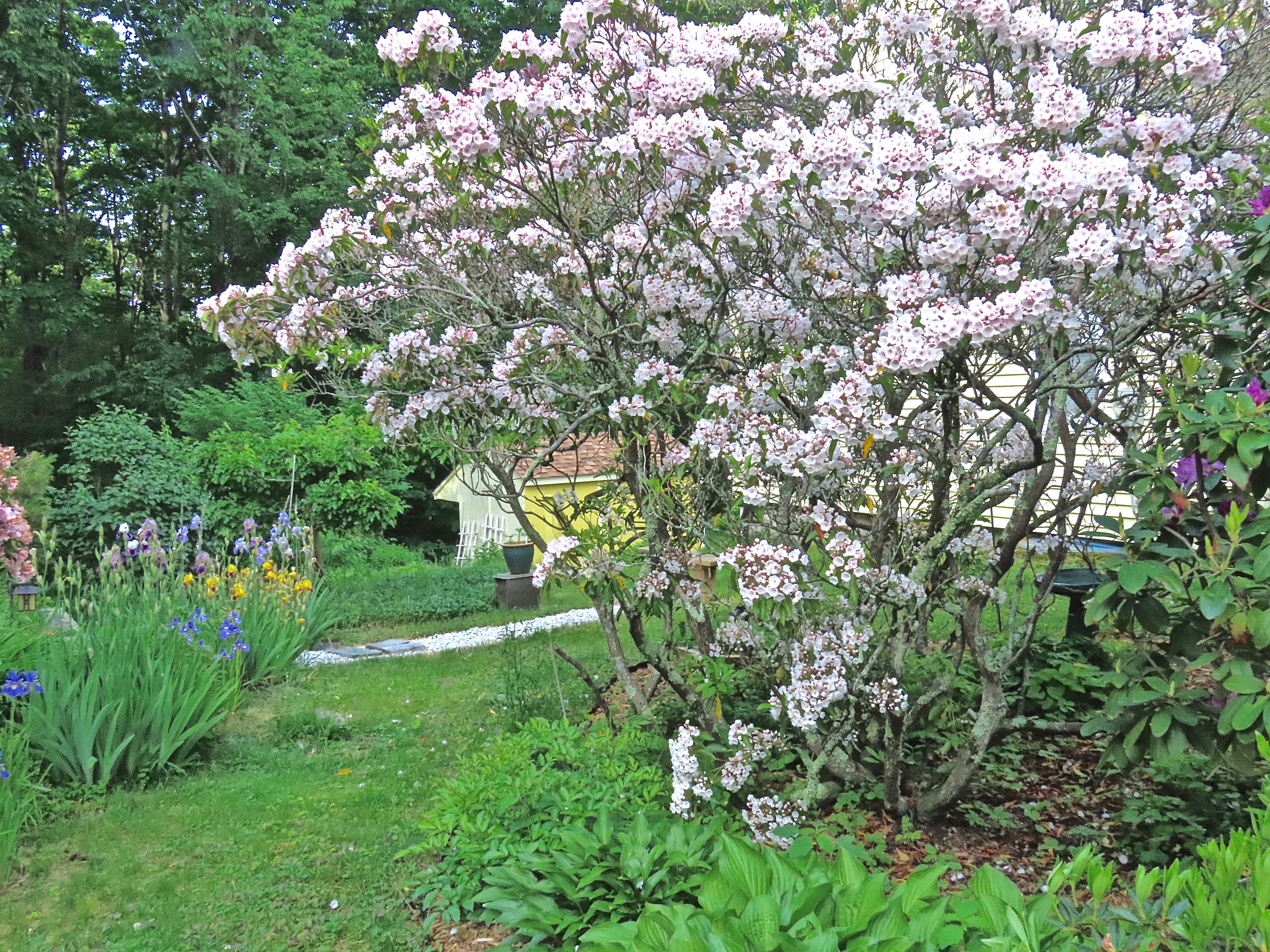
The Mountain Laurel is native to the eastern United States, and was first recorded in America in 1624.

Mountain Laurel is in full bloom in Massachusetts this week.
Cup-shaped buds open up to display tiny blossoms. These blossoms are sometimes said to look like miniature origami rice bowls .
Each blossom has five fused petals that surround ten stamens. Each stamen looks like a tiny half-pulled stitch.
The leaves are evergreen, providing year-round interest to the New England landscape.
The purple tones of a nearby rhododendron contrast with the pinkish laurel blossoms.
Mountain Laurels usually live for fifty to seventy-five years. Happily, this laurel in my yard is at least seventy years old, and is still going strong.

The Queen of Shrubs

The easy-to-grow and fragrant lilac was brought from Europe to New England by the early colonists. Today this “Queen of Shrubs” is ubiquitous in Massachusetts.

Better Homes and Gardens notes that:

“Lilacs are known for their hardy nature and long lives—many lilac shrubs live to be more than 100 years old. Because of their life span, they often survive longer than the home of the gardener that planted them. So, if you’re on a country road and see a few seemingly-random lilac bushes, there was most likely a house or farm there in the last century.”