Category: Seasons

Something Told The Wild Geese

Something Told the Wild Geese    
by Rachel Field     

Something told the wild geese     
It was time to go.     
Though the fields lay golden
Something whispered,—‘Snow.’
Leaves were green and stirring,
Berries, luster-glossed,
But beneath warm feathers
Something cautioned,—‘Frost.’
All the sagging orchards
Steamed with amber spice,
But each wild breast stiffened
At remembered ice.
Something told the wild geese
It was time to fly,—
Summer sun was on their wings,
Winter in their cry.

Close Up and Far Away

Female, Male and Juvenile Hooded Mergansers on the Wildlife Pond
Blue Jay and Northern Cardinal Near the Bird Feeders
Gray Squirrel Swinging in the Copse Near the Bird Feeders
Common Grackle Hunting Seeds on the Ground
Female and Male Mallard on the Far Side of the Wildlife Pond
Eastern Cottontail with a Gray Squirrel and Sparrows Near the Visitor’s Center
Eastern Towhee and Blue Jay Under the Feeders
Eastern Cottontail Close-up
Eastern Towhee Under the Bird Feeders

Feathers and Shells

Painted Turtles and Canada Geese share a sunny afternoon together at the Wachusett Meadow Wildlife Sanctuary, Princeton, MA.

I enjoy experimenting with the continuous shutter setting on my bridge camera.

In contrast, I use the built in close-up lens with the turtles sunning on the far side of the pond.

Did You Hear?

An Eastern Meadowlark, which is becoming rarer in many parts of Massachusetts, visited the Audubon Sanctuary recently.

“There’s a Meadowlark in the South Meadow!”
“Heads up, Painted Turtles!”
The Red-winged Blackbird, Mourning Dove and Northern Cardinal have a plan.
“Let’s go check it out!”
The Eastern Meadowlark rests in the grass.

Bluebird Picnic

Eastern Bluebirds flew into town and invited their friends for a feast at the feeders.

Male Eastern Bluebird, Wachusett Meadow Wildlife Sanctuary, Princeton, MA
Female Eastern Bluebird
Female Bluebird, Blue Jay, Female Cardinal

Female Bluebird, Gray Squirrel

Downy Woodpecker, Male Bluebird

Winter Meditation

Zen inspired elements enhance my winter garden.

Zen inspired landscaping offers opportunities for meditation and contemplation in my winter garden. Bamboo is one of the loveliest and most recognizable features.
An invitation to sit is provided by a worn stair step. Below it are smooth hand chosen stones from the Atlantic Ocean.
Rocks suggest mountains, stability…
…and sculptures.
The aged laurel bush, worn by time and weather, is a favorite shelter for native and migrating birds.
A weathered bird feeder ornament intrigues our feathered visitors.

Frozen Meadow Trek

Photos from a winter walk at Mass Audubon Wildlife Sanctuary in Princeton, MA,

It was a chilly 22 degrees at Wachusett Meadow today.
The Beaver Lodge was coated in snow and surrounded by ice.
A light layer of ice on the snow in the South Meadow shone in the low winter light.

Bluebird houses, abandoned until the spring, are a familiar sight along numerous trails.

The cross country skiers and snowshoers who trekked before me made my hike a bit easier today.

A New Year’s Wish: Lonely Fences, Revisited

A winter walk along the winding road to St. Joseph’s Abbey during the Omicron upsurge.

Aging wooden fences line the twisting, hilly, half-mile long road that leads to St. Joseph’s Abbey. The views of fields and distant hills are lovely and uplifting. The walk to the top takes stamina, and provides time for meditation.
Occasionally, one notices posts and railings that need repair.
A closer inspection shows the effect of time and weather.
Closer to the top, the hills beyond come into view.
Finally, the land levels off.
The journey is complete.
Inside the abbey, visitors can rest in the quiet glow of stained glass.
May we all find moments of rest and hope in the New Year.

First Snow, Part Two

The view driving away from the Town Common on Barre Road, Hardwick, MA.
“Meadowbrook” was part of a former dairy.
A typical colonial home of the late 1700s and early 1800s.
Thick, winding stone walls can be viewed throughout the town.
A traditional style Cape Cod home on Ridge Road.
A view of the Town Common, from the left to right: the First Universalist Church, the Historical Society and the Town Hall.
The bell tower of the Town Hall.
The Paige Memorial Fountain with fields beyond, which are used for showing sheep during the Hardwick Fair.
Paige Memorial Fountain with the Congregational Church and a Coffeehouse behind it. (The Coffeehouse was formerly the general store.)
The coffeehouse also includes the Hardwick Post Office.
An historical cemetery abuts the Town Hall.
Holiday decorations on the First Universalist Church capture the imagination.

Tunnel Vision

A tunnel on the Mass Central Rail Trail provides a surprising sight for both art and nature lovers.

One can walk through the hill on the Mass Central Rail Trail in Rutland, MA.
Brilliant colors and exposed layers of rock vie for attention.

Unexpectedly, hikers spy a tunnel up ahead.
Inside, wanderers find a colorful woodland mural created by local amateur artists of all ages.
Flora and fauna of the nearby woods and fields are depicted on the walls in this work in progress.

Nature artwork blends with the leaf-strewn path at the end of the tunnel.
And it’s off on the open road (or trail) once again.

Mass Central Rail Trail

An autumn stroll on one of the Mass Central Rail Trail’s fifty-one miles of linear park.

Mass Central Rail Trail, Rutland MA
Partners in twenty-six communities are working to reopen a disused railroad line that spanned 104 miles from Northampton to Boston, MA. The line is being converted to a linear park for hiking, biking, jogging and relaxing. So far, fifty-one miles have been repurposed.

“Mountain Place”

“Wachusett” is an Algonquin word meaning “mountain place”. Wachusett Mountain in Princeton, MA has been a popular destination for hikers, skiers and sightseers for centuries. Local tribes, such as the Nipmucs, camped here. In the nineteenth century, Henry David Thoreau explored this mountain and described his visit in one of his journals.

Mt. Wachusett reveals an iconic view of New Hampshire’s Mt. Monadnock.
Wachusett’s ski lifts are popular with sightseers in the fall.

The Bicentennial Trail is one of ten trails of varying difficulties frequented by hikers each year.

Heron Hike 2

The foliage in Central Massachusetts is becoming more brilliant each day. Swamp maples surrounding the beaver lodge at Wachusett Wildlife Sanctuary are nearly at peak color.

Meanwhile, the juvenile Great Blue Heron featured in the previous post is still roaming the sanctuary. It seems in no rush to migrate, perhaps because of the warm weather this week.

Beaver Lodge, Wildlife Pond, Wachusett Meadow Wildlife Sanctuary

Juvenile Great Blue Heron, South Meadow

Lunch Break

From apples to zinnias: visitors can choose from a wide variety of tasty treats in my garden this week.

Eastern Cottontail Rabbit/ Scarlet Emperor Greens
Female Ruby-throated Hummingbird/Scarlet Emperor Bean Blossoms
Eastern Chipmunk/Acorns
Downy Woodpecker/Baldwin Apple
Monarch Butterfly/ California Giant Zinnia

Painted (Turtle) Portrait Redux

Out with the old, and in with the new: a turtle sheds its shell.

Last June, I photographed a turtle on this exact log at Mass Audubon Wachusett Meadow. Yesterday, the turtle I saw there was shedding its shell. As a turtle grows larger, the outer portion of the shell, called the scutes, must fall off to make way for the newer, larger scutes.

Iridescence

Glistening Ruby-throated hummingbirds will be heading south for the winter soon.

According to the Merriam Webster Dictionary iridescence is:

1 : a lustrous rainbowlike play of color caused by differential refraction of light waves (as from an oil slick, soap bubble, or fish scales) that tends to change as the angle of view changes
2 : a lustrous or attractive quality or effect
The Ruby-throated hummingbird is found throughout Massachusetts during the warm months. This female paused on the branch of a nearby apple tree recently, providing me with a close-up of her luminous feathers.

Meadow Magic Hour

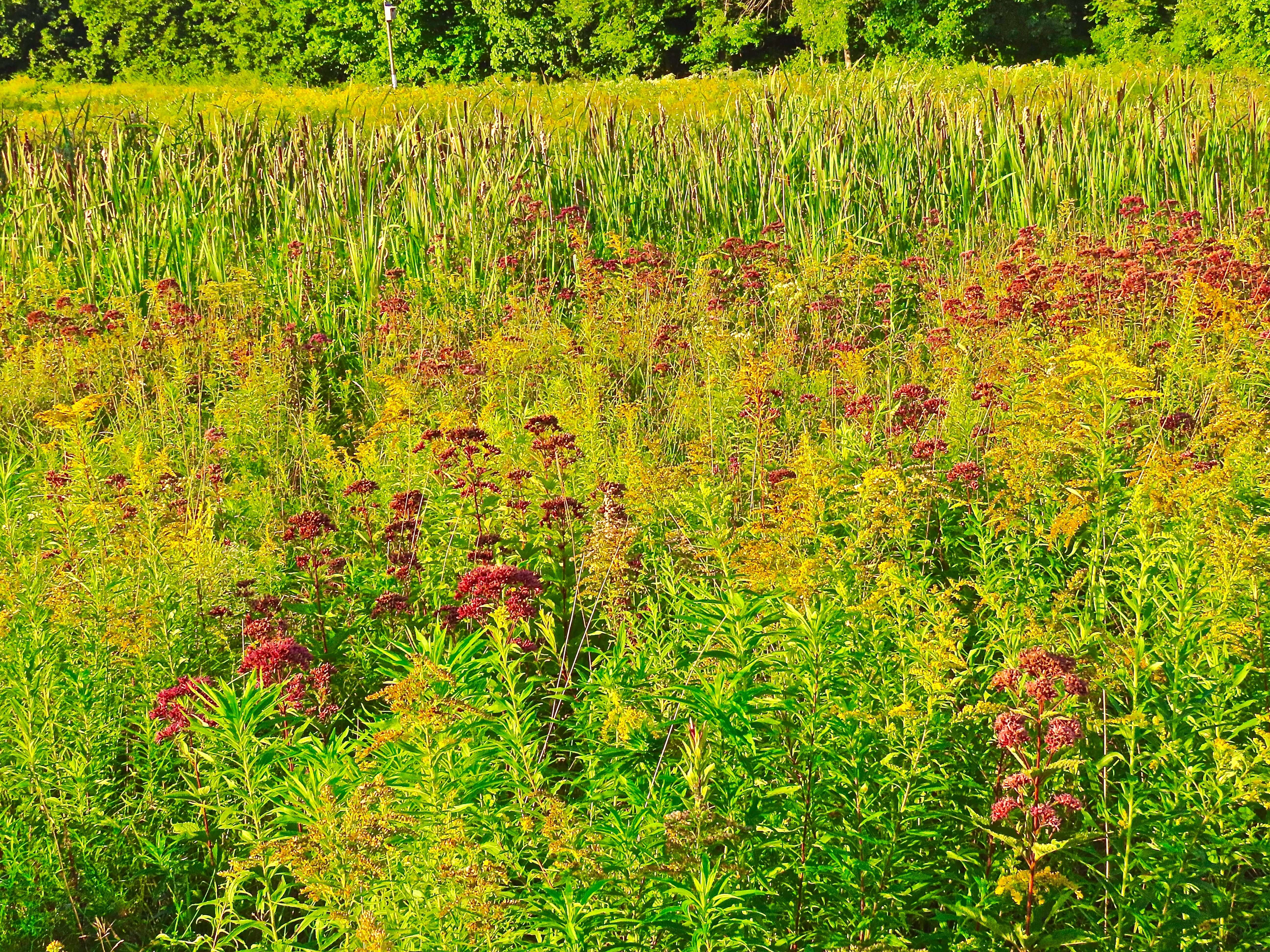
Late August meadows in New England foretell the bold autumn tree colors yet to come.

On a late August evening, Wachusett Meadow in Princeton is awash in gold tones and green shadows. The top of the boathouse rises up mysteriously behind tall wildflowers.
Looking across the stone wall to the North Meadow, raking light accentuates patches of green mown grass that contrast with alternating waves of white asters and goldenrod.
In storybook fashion, a shady path descends into the South Meadow.
Autumnal reds and yellows carpet the landscape.
Corridors of Joe Pye Weed capture the eye.
Wild asters surprise with their spiky yellow globes.
Unsurprisingly, I am not alone in admiring this magical habitat.

Monarch of the Meadow

Increased monarch butterfly activity is a sign of fall at Mass Audubon’s Wachusett Meadow Wildlife Sanctuary.

This thoughtfully placed bench at Mass Audubon’s Wachusett Meadow Wildlife Sanctuary is a perfect place to sit and contemplate monarch butterflies.
The North and South Meadows are ablaze with goldenrod in the late summer. Goldenrod is an important food source for monarchs.
The majestic monarch has a wingspan of three to four inches.
In addition to goldenrod, adult monarchs feed on a wide variety of nectar bearing flowers in preparation for their migration to Mexico.

With their striking orange and black coloring, monarchs are one of the most easily recognized butterflies in North America.

The goldenrod this monarch is feeding on does not cause allergies in humans. Ragweed, which blooms at the same time, is the allergy culprit.

Sparky, Marietta, Petite and Crackerjack

It’s marigold time in my garden.

I usually buy six-packs of marigold plants around Memorial Day. But last winter, dreaming of spring, I bought a set of four different types of marigold seeds. It turns out that four packages contain thousands of seeds. Now I have an explosion of color and texture weaving through the yard. And what a bargain! I have seeds left over to plant next year.
Sparky Mix Marigolds have wavy petals of orange, yellow, crimson, gold and bicolor. They are mid-sized, at around fourteen inches tall. These popular companion plants attract pollinators; they are “on duty” as a border around the squash garden.
As their name suggests, Dainty Marietta Marigolds are quite small, and known for the bright yellow petals with maroon centers. They have been the most difficult marigolds for me to nurture, but their delicate flowers are delightful.
Petite Mix Marigolds are only 8 to 10 inches in height, but they bloom in all colors. They are in containers around the yard, and used as annual borders. They are so abundant, that even if the rabbits find them, there is enough to share.
At three to four feet tall, the Crackerjack Marigolds are eye-catching, with large ruffles of yellow and orange blooms. They lend a festive feeling to the yard.

Books and Bee Balm

I grew up in a rural town in Western Massachusetts, where a large patch of bee balm featured prominently in our garden each summer. One day an elderly couple, complete strangers, stopped their car to ask my father what the fiery red blooms in the garden were.

“It’s bee balm, a perennial. Would you like some?”

He dug up a clump for the pair to take to their summer home at the edge of town.

A few days later, the couple reappeared with a box of children’s books. They were retired teachers, who had noticed my siblings and me playing in the yard.

“We have collected so many books over the years, and since we are retired, we don’t need them. Would your children like some?” they asked my father.

That summer, and for many summers thereafter, the couple brought boxes of books of a variety of genres. Some were almost new; some were gently worn. Each box was a thoughtful gift.

The sight of bee balm might bring thoughts of insects, bright flower petals in a salad, or perhaps herbal tea to most people.

But me? I simply think of books.

Bees, butterflies and hummingbirds are especially attracted to bee balm, which is a member of the mint family. Monarda, bergamot, horsemint, and oswego tea are other names for this plant. It has many uses, being found in everything form skin salves to digestive teas to salad toppers.
Bee balm getting ready to bloom.
The blooming time for bee balm is July through late summer. Cutting back the blooms as they finish flowering will encourage regrowth and extend the blooming period.
A Silver Spotted Skipper butterfly visits.
Although bee balm likes sun, it tolerates partial shade, as shown here growing in a mix of ferns and Queen Anne’s Lace.
Vigorous bursts of bee balm contrast with the calm of the apple tree in my yard. Time to sit in the shade and enjoy a book!

Wachusett Meadow

A meadow is an area with shallow ground water that allows grasses and wildflowers to flourish. Meadows support a wide range flora and fauna that could not thrive in other habitats, including flowers for native bees and other pollinators.

A recent ramble through this habitat at Mass Audubon’s Wachusett Meadow enabled me to study and appreciate the flowers and grasses up close. In turn, three common meadow creatures kept an eye on me as I walked.

Eastern Bluebird
Common Purple Vetch and Other Meadow Grasses
Wild Turkey

Red-winged Blackbird
Common Milkweed

For more information visit: https://www.massaudubon.org/get-outdoors/wildlife-sanctuaries/wachusett-meadow

To learn more about meadow habitats, visit http://www.magnificentmeadows.org.uk/conserve-restore/importance-of-meadows

Nature’s Stitchwork

The Mountain Laurel is native to the eastern United States, and was first recorded in America in 1624.

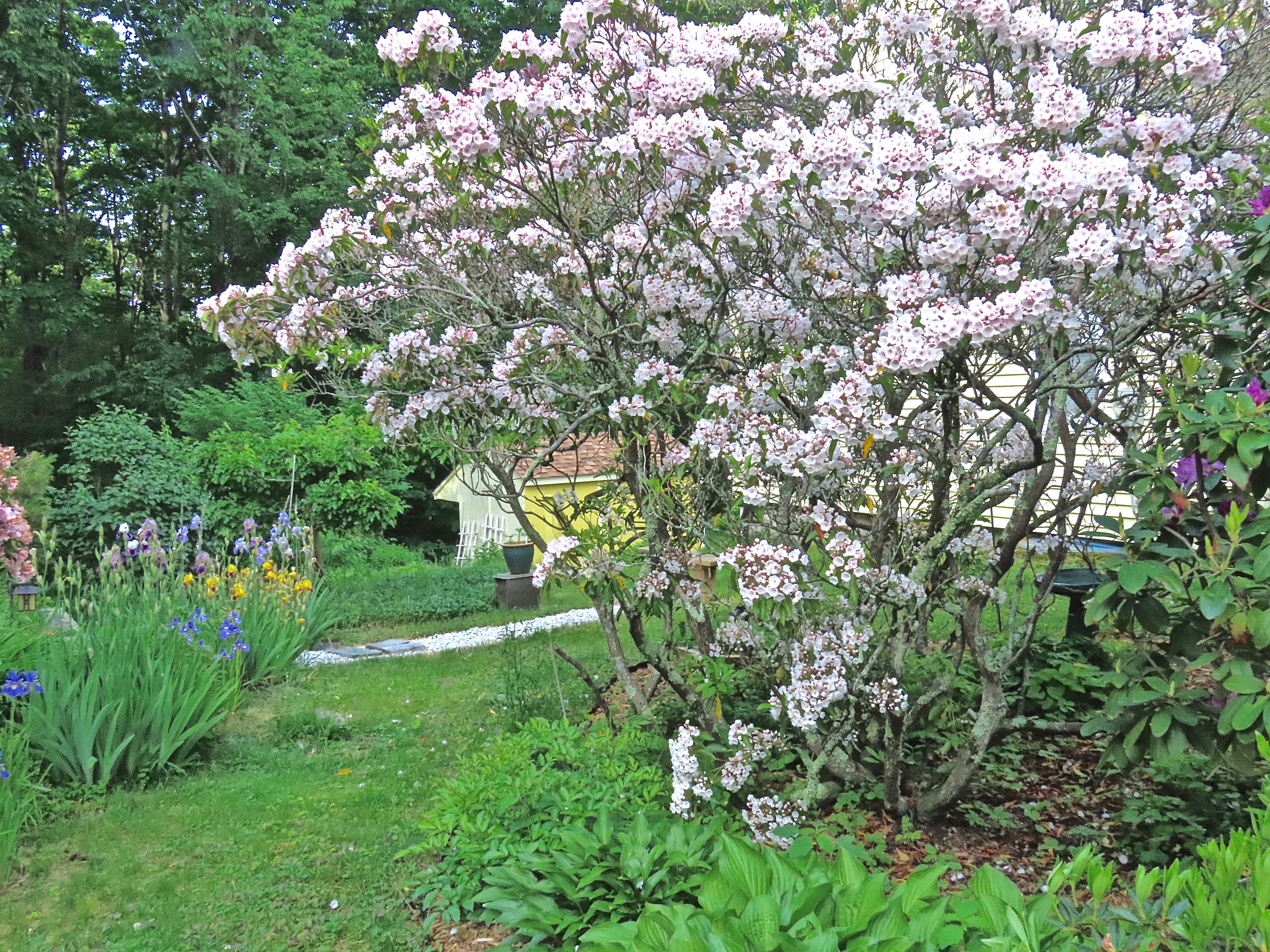
Mountain Laurel is in full bloom in Massachusetts this week.
Cup-shaped buds open up to display tiny blossoms. These blossoms are sometimes said to look like miniature origami rice bowls .
Each blossom has five fused petals that surround ten stamens. Each stamen looks like a tiny half-pulled stitch.
The leaves are evergreen, providing year-round interest to the New England landscape.
The purple tones of a nearby rhododendron contrast with the pinkish laurel blossoms.
Mountain Laurels usually live for fifty to seventy-five years. Happily, this laurel in my yard is at least seventy years old, and is still going strong.

A Yard For People and Rabbits

I expect the rabbits to appear in my yard for “Summer Vacation” any day now.
High raised beds keep the bunnies out of the Spring greens. However, they are welcome to all the lawn clover they desire.
New fencing around the pole beans and squash means the beans are off-limits to rabbits this year, as well. Sometimes they pick at the hostas nearby, and that is acceptable to me.
Tall pots encase my favorite red-blossomed Scarlet Emperor beans. The wild bleeding hearts next to the pots are plentiful, though.
Removable fencing keeps the largest vegetable bed protected, but with easy access for me.
Grow bags keep the Yukon Gold and Early Red potatoes safe. However, the clover and wild daisies left in between the bags are available for munching.
Wild strawberries are everywhere in the yard. The rabbits can eat their fill!
The cold frame provides great protection from both weather and critters in three seasons.
Kale is safe in a small enclosed garden on the edge of the woods.
Time to get some fencing around this cucumber and nasturtium tripod. If you have heard that rabbits don’t like nasturtium, don’t believe it!
The rabbits have ignored the tomatoes in previous years. Plenty of Solomon’s Seal nearby to eat instead.
Garlic has not caught the rabbit’s fancy, either. But will they go for the lettuce purposely planted among it? Stay tuned…
Hopefully, this blue bucket will protect the eggplant. Wild Strawberry is nearby as an alternate selection.
Thank goodness the blueberry bush is out of reach! Alas, the birds are drawn to it like magnets.
A restful area for both people and critters.
One final touch added after the garden is planted.
Wishing you wonderful times outdoors this season!

The Queen of Shrubs

The easy-to-grow and fragrant lilac was brought from Europe to New England by the early colonists. Today this “Queen of Shrubs” is ubiquitous in Massachusetts.

Better Homes and Gardens notes that:

“Lilacs are known for their hardy nature and long lives—many lilac shrubs live to be more than 100 years old. Because of their life span, they often survive longer than the home of the gardener that planted them. So, if you’re on a country road and see a few seemingly-random lilac bushes, there was most likely a house or farm there in the last century.”